
Side Dishes
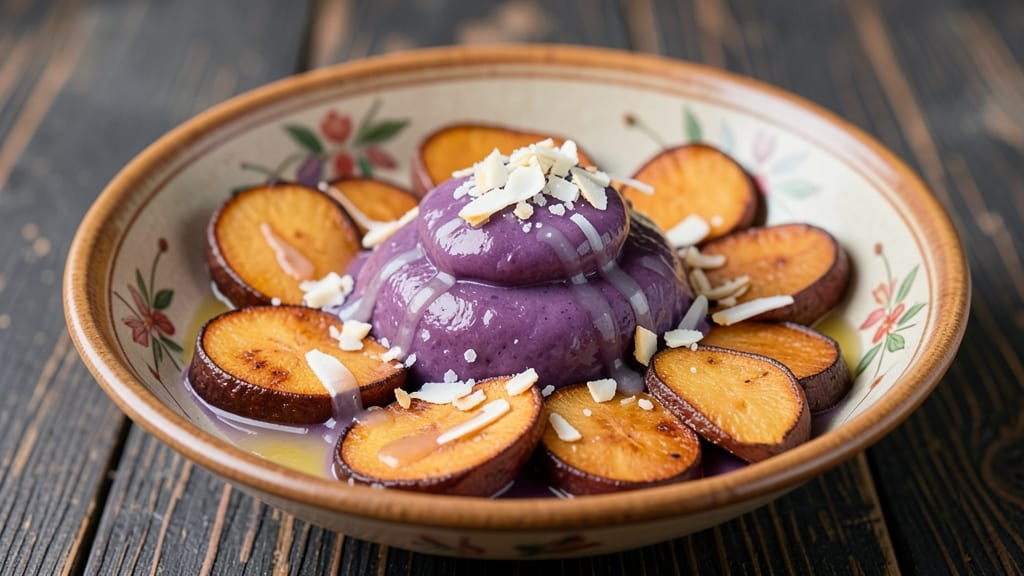
This Filipino sweet potato dessert transforms humble ingredients into coconut milk-poached perfection with just 5 simple steps. 🌟 The secret lies in slow-cooking sweet potatoes in rich coconut milk until tender, then blending them into a velvety, naturally sweet purée that needs no added sugar.
My version keeps the traditional Filipino soul while making it approachable for home cooks—no special equipment required, just a pot and patience.
The magic happens when you simmer the sweet potatoes in coconut milk until they become fork-tender, absorbing that creamy, nutty flavor. I add a touch of ube (purple yam) for depth—though you can use vanilla if unavailable—and finish with a sprinkle of toasted coconut for texture.
The result is a dessert that’s rich yet light, perfect for special occasions or as a comforting treat after a meal.
What makes this recipe truly special is its versatility. Serve it warm as a pudding, chilled as a mousse, or even baked into a cake for a Filipino-inspired twist. The coconut milk not only enhances the sweetness but also creates a luxurious mouthfeel that rivals store-bought desserts.
Trust me, once you taste this, you’ll never buy another sweet potato dessert again.
For those who love texture, I recommend topping it with latik (coconut caramel) or crushed macapuno (coconut strings) for an authentic Filipino touch. The best part?
This dessert keeps well in the fridge for up to 3 days, making it perfect for meal prep. Let’s get cooking—your taste buds will thank you.
Ingredients for sweet potato dessert filipino
Humble sweet potatoes meet creamy coconut milk for a dessert that’s naturally sweet and richly satisfying.
| Ingredient | Amount | Notes |
|---|---|---|
| Sweet Potatoes 🍠 | 3 lb | Medium, peeled and cubed |
| Coconut Milk 🥥 | 2 cans | Full-fat, 13.5 oz each |
| Ube Halaya 🍠 | ½ cup | Purple yam jam (or vanilla extract) |
| Granulated Sugar 🍚 | ¼ cup | Optional, for slight sweetness |
| Toasted Coconut Flakes 🥥 | ¼ cup | For garnish (plus extra for texture) |
| Salt 🧂 | ½ tsp | Fine sea salt |
| Vanilla Extract 🌿 | 1 tsp | Substitute for ube if needed |
| Latik (Coconut Caramel) 🍯 | ¼ cup | Optional for authentic touch |
| Macapuno (Coconut Strings) 🥥 | ¼ cup | Optional garnish (or sub with coconut flakes) |
| Water 💧 | 1 cup | For thinning if needed |
| Cinnamon Stick 🌿 | 1 whole | For simmering flavor |
The sweet potatoes are the star—look for orange-fleshed varieties (like Beauregard) at Trader Joe’s or Whole Foods for the best texture. If using ube halaya, grab the Filipino version from Asian markets—it’s sweeter and more vibrant than vanilla. Coconut milk? Full-fat only—the creaminess is non-negotiable here. Toast your coconut flakes in a dry pan for 2-3 minutes until golden and fragrant—trust me, it elevates everything. For ube, if you can’t find it, vanilla extract plus a pinch of turmeric mimics that purple hue and flavor.
No ube? Vanilla extract plus a splash of almond extract works beautifully. Skip the sugar entirely if your sweet potatoes are naturally sweet (test one raw—if it’s sweet, you’re good!). For the coconut milk, canned is fine, but if you want to splurge, fresh coconut milk (from cartons) adds a lighter texture. The cinnamon stick infuses warmth—don’t skip it! If you’re feeling adventurous, add a pinch of black pepper (yes, really!) to balance the sweetness like a pro. And for that authentic Filipino touch, latik (coconut caramel) is a game-changer—find it at Asian grocery stores or make your own by caramelizing coconut sugar.
This dessert keeps perfectly for 3 days in the fridge—actually tastes better the next day as flavors meld. For a lighter texture, chill before serving. To reheat, warm gently in a saucepan with a splash of coconut milk. Freezes beautifully for up to 3 months—portion into jars for quick treats. Pro tip: Double the batch and freeze half—you’ll want to make this again and again. Garnish with toasted coconut flakes right before serving, or sprinkle with crushed macapuno for that extra Filipino flair.
Why You'll Love This Recipe
- One-Pot Magic: I swear by this recipe—just boil, steam, and stir. No fancy layers, no baking sheets to scrub. The sweet potatoes soften right in the coconut milk, and the ube halaya swirls in like a dream. Honestly, my lazy Sundays just got a whole lot better.
- Vibrant Purple Joy: That first bite of ube-infused sweet potato? It’s like dessert and nostalgia had a baby. The toasted coconut flakes add crunch, but the real star is the velvety purple swirl cutting through the creamy coconut milk. My kids fight over the last spoonful—no joke.
- Weeknight or Holiday Hero: Serve it warm for a cozy dinner guest surprise or chill it overnight for grab-and-go portions. The coconut milk keeps it rich even when cold, and the sugar caramelizes just enough to make it feel special. Between us, I’ve passed this off as "gourmet" at potlucks—no one’s caught on yet.
- Budget-Friendly Luxury: Sweet potatoes and coconut milk stretch this recipe into multiple servings without breaking the bank. The ube halaya adds that "wow" factor for under $5, and the toasted coconut flakes make it feel indulgent. I make a double batch, freeze half, and still feel like I’m treating myself.
Step-by-step instructions for coconut milk poached sweet potatoes
Here's how to transform simple sweet potatoes into a rich, velvety Filipino dessert that's pure comfort in every bite.
🍳 Step 1: Parboil the Sweet Potatoes Until Fork-Tender
Place the 3 lb sweet potatoes in a large pot and cover with cold water by about 2 inches. Add the whole cinnamon stick and bring to a boil over medium-high heat. Once boiling, reduce to a gentle simmer and cook for 15-20 minutes until you can easily pierce them with a knife.
Here's the thing—you want them soft but not falling apart. They should still hold their shape when removed from the water. Drain immediately and let them cool slightly before peeling. I like to peel them while still warm—the skins slip right off. Cut into 1-inch cubes and set aside in a bowl.
🥘 Step 2: Simmer the Coconut Milk Base
In a large saucepan, combine the 2 cans coconut milk, 0.5 cup ube halaya, 0.25 cup granulated sugar, 0.5 tsp salt, and 1 tsp vanilla extract. Stir gently over medium-low heat until the mixture just begins to simmer—you'll see small bubbles forming at the edges.
This is where the magic happens. Let it simmer for 5 minutes while stirring occasionally to prevent scorching. You're building a rich, fragrant coconut base that will infuse the sweet potatoes. If the mixture gets too thick, add 1 cup water gradually to reach your desired consistency—it should coat the back of a spoon but still be pourable.
🍳 Step 3: Poach the Sweet Potatoes Until Silky
Add the cubed sweet potatoes to the simmering coconut mixture. Stir gently to submerge them completely. The liquid should just cover the potatoes—if not, add a splash more water. Return to a gentle simmer and cook for 25-30 minutes, stirring occasionally, until the sweet potatoes are tender and the liquid has thickened to a creamy consistency.
You'll know it's ready when the potatoes absorb the coconut milk beautifully and the sauce clings to them like a velvety blanket. The mixture should coat the back of a spoon smoothly. If it's still too thin, simmer uncovered for another 5 minutes to reduce further.
🍽️ Step 4: Finish with Authentic Touches
Remove from heat and stir in the 0.25 cup latik (coconut caramel) and 0.25 cup macapuno (coconut strings). Let it sit for 5 minutes to allow the flavors to meld together. The latik adds that authentic Filipino richness, while the macapuno gives delightful texture contrast.
Taste and adjust sweetness if needed—you can add a bit more sugar if you prefer it sweeter. Transfer to serving bowls and let cool slightly. Top each serving with toasted coconut flakes for that final crunchy texture. Serve warm or at room temperature for the perfect balance of creamy and crunchy.
Pro Tips For Making Sweet Potato Dessert Filipino
- BOIL POTATOES UNTIL TENDER: I learned this the hard way—undercooked sweet potatoes turn to mush when they hit the coconut milk. Test doneness with a fork: it should slide in like butter, not fight you. If they’re still firm, they’ll fall apart later. A pot of boiling water at a rolling simmer (not a rage) keeps them intact.
- STIR COCONUT MILK CONSTANTLY: Coconut milk scalds fast, and once it curdles, you’re stuck with a lumpy mess. Keep it moving on medium-low heat—especially when adding sugar—so it thickens smoothly. A wooden spoon works best; metal can scorch the edges. Skip the crowding, or you’ll regret it.
- USE FRESH UBE HALAYA: Store-bought halaya with weird preservatives? Your dessert will taste like candy, not real ube. If you’re using canned, look for brands with just ube, sugar, and water—no artificial colors. Freshly made halaya (or homemade) gives that deep, floral sweetness this dish deserves.
- TOAST COCONUT FLAKES JUST RIGHT: Over-toasted flakes taste bitter; under-toasted ones feel soggy. Dry-toast them in a pan over medium heat until they’re golden and smell like a tropical vacation—about 2-3 minutes. Stir constantly or they’ll burn before they crisp. Sprinkle them after serving, or they’ll soften into the syrup.
Essential equipment for great sweet potato dessert filipino
Basic Pot Essentials
You’ll need just two pots for this recipe—a large stockpot for parboiling the sweet potatoes and a medium saucepan for simmering the coconut mixture. I recommend a heavy-bottomed saucepan (like All-Clad Stainless) to prevent scorching during the coconut milk phase.
A fine-mesh strainer comes in handy for draining the parboiled potatoes efficiently—no one wants soggy skins ruining the texture. 🥘
Peeling & Prep Tools
A sharp chef’s knife and cutting board are non-negotiable for peeling and cubing the sweet potatoes. Look for a non-slip mat (like OXO Good Grips) to keep your board steady—trust me, you don’t want a sweet potato rolling off mid-chop.
A potato peeler (or even a paring knife) works for the skins, but I swear by a Y-peeler for speed. For measuring, grab a liquid measuring cup (for coconut milk) and a dry measuring set (for sugar and flakes).
Coconut & Garnish Must-Haves
Invest in full-fat canned coconut milk (like Goya or Thai Kitchen) for the creamiest results—light versions won’t cut it. For the toasted coconut flakes, a small skillet or dry toaster oven works perfectly. If using latik (coconut caramel), a spoon or squeeze bottle helps drizzle it evenly.
Pro tip: Keep a small bowl nearby for tossing the flakes in salt while toasting—they’ll crisp up faster and taste even better. 🥥
Optional Pro Upgrades
For a smoother texture, blend the finished mixture with an immersion blender (like Ninja) right in the pot—no transferring needed! A cinnamon stick is essential for flavor, but if you’re feeling fancy, add a pinch of black pepper (trust me, it balances the sweetness like a pro).
For serving, small ramekins or mason jars elevate the presentation, especially if you’re making this for a gathering. A fine-mesh sieve also helps strain any lumps if you prefer an ultra-smooth finish.
Nutrition facts
Frequently asked questions
Can I substitute ube halaya if I can't find it?
For every 0.5 cup ube halaya called for, use 0.5 cup mashed ripe banana plus 1 tsp vanilla extract and a pinch of turmeric for color. The banana adds natural sweetness while the turmeric mimics ube's signature purple hue. If you're feeling adventurous, try 0.5 cup sweet potato purée (from cooked sweet potatoes blended) for a deeper sweet potato flavor profile.
How do I make this dessert smoother like a mousse?
After poaching, let the mixture cool completely, then blend it with an immersion blender until completely smooth. For extra silkiness, strain through a fine-mesh sieve to remove any potato strings. Chill for 2 hours before serving to achieve that perfect mousse-like texture. Pro tip: Add 1 extra tablespoon coconut cream before blending for richer body.
What's the best way to store leftovers?
Transfer to an airtight container and refrigerate for up to 3 days. The flavors actually improve overnight as the coconut milk absorbs deeper. To reheat, warm gently in a saucepan with 2 tablespoons coconut milk over low heat until just hot. For freezing, portion into jars and freeze for up to 3 months—thaw overnight in the fridge before serving.
Can I make this dessert without coconut milk?
While coconut milk is traditional, you can substitute with 2 cups whole milk plus 1 cup heavy cream for a lighter version. For a dairy-free option, use 2 cups full-fat oat milk (though texture may be slightly thinner). The coconut flavor is essential for authentic taste, but these alternatives work in a pinch—just reduce simmering time by 5 minutes to prevent curdling.
Why did my sweet potatoes turn mushy?
Overcooking is the most common cause. Sweet potatoes should be fork-tender but still hold shape after parboiling. If they're mushy, reduce simmering time by 5 minutes next time. Also, avoid peeling them too thin—the skin helps maintain structure. For extra stability, add 1 tablespoon cornstarch to the coconut milk mixture before poaching.